产品详情
-
产品名称
重组人LRFN2蛋白
-
蛋白种属
人
-
表达宿主
大肠杆菌
- Unitprot ID
-
蛋白序列
MNHKVHHHHHHGGSCPKYCVCQNLSESLGTLCPSKGLLFVPPDIDRRTVELRLGGNFIIHISRQDFANMTGLVDLTLSRNTISHIQPFSFLDLESLRSLHLDSNRLPSLGEDTLRGLVNLQHLIVNNNQLGGIADEAFEDFLLTLEDLDLSYNNLHGLPWDSVRRMVNLHQLSLDHNLLDHIAEGTFADLQKLARLDLTSNRLQKLPPDPIFARSQASALTATPFAPPLSFSFGGNPLHCNCELLWLRRLERDDDLETCGSPGGLKGRYFWHVREEEFVCEPPLITQHTHKLLVLEGQAATLKCKAIGDPSPLIHWVAPDDRLVGNSSRTAVYDNGTLDIFITTSQDSGAFTCIAANAAGEATAMVEVSIVQL
-
克隆构建
DNA encoding 21-379 aa (Q9ULH4) were fused with N-terminal 6His tag.
-
蛋白纯度
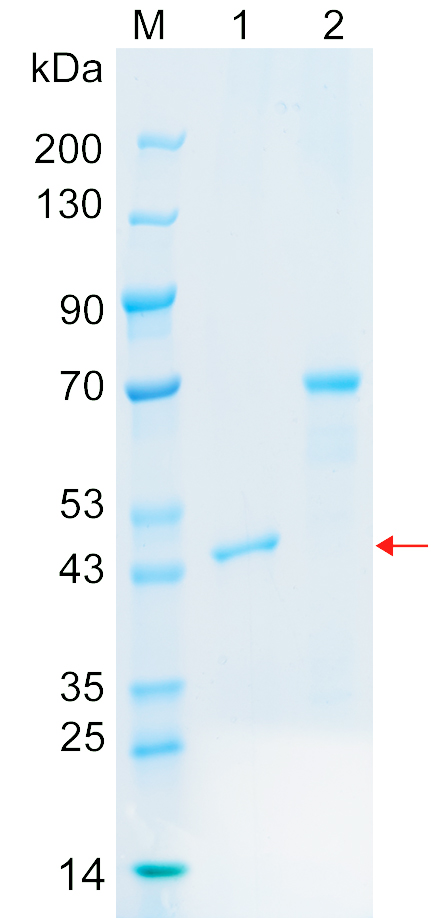
>90%, by SDS-PAGE with Coomassie Brilliant Blue staining.
-
蛋白活性
Not tested.
-
分子量
Predictes a molecular mass of 41.38 kDa. In SDS-PAGE under reducing conditions, it migrates as an approximately 42 kDa band.
-
蛋白全名
Leucine-rich repeat and fibronectin type-III domain-containing protein 2
-
蛋白描述
Recombinant Human LRFN2 (Leucine-rich repeat and fibronectin type-III domain-containing protein 2) fragment (residues 21-379) is a high-purity protein designed for neuroscience and cell biology research. This fragment fully encompasses the LRRNT, LRRCT, and Ig-like functional domains, making it an ideal tool for studying neurite outgrowth, NMDA receptor regulation, and synaptic adhesion mechanisms.
Leucine-rich repeat and fibronectin type-III domain-containing protein 2 (LRFN2), also known as Synaptic adhesion-like molecule 1, is a membrane protein that promotes neurite outgrowth in hippocampal neurons and enhances cell surface expression of NMDA receptor subunits GRIN1 and GRIN2A. It is localized to the postsynaptic cell membrane and synapses, where it may play a role in redistributing DLG4 to the cell periphery. As a single-pass type I membrane protein, LRFN2 functions in synaptic adhesion and neuronal development, making it a significant target for neurobiological research.
-
检测结果
Recombinant LRFN2 protein (His tag) SDS-PAGE
M: Marker; Lane 1: RFN2; Lane 2: BSA
-
发货形式
Lyophilized from sterile PBS, pH 7.4
-
内毒素
Please contact the lab for more information.
-
保存条件
Store it under sterile conditions at -20℃ to -80℃. It is recommended that the protein be aliquoted for optimal storage. Avoid repeated freeze-thaw cycles.