产品详情
-
产品名称
重组人AP1M1蛋白
-
蛋白种属
人
-
表达宿主
大肠杆菌
- Unitprot ID
-
蛋白序列
MNHKVSASAVYVLDLKGKVLICRNYRGDVDMSEVEHFMPILMEKEEEGMLSPILAHGGVRFMWIKHNNLYLVATSKKNACVSLVFSFLYKVVQVFSEYFKELEEESIRDNFVIIYELLDELMDFGYPQTTDSKILQEYITQEGHKLETGAPRPPATVTNAVSWRSEGIKYRKNEVFLDVIESVNLLVSANGNVLRSEIVGSIKMRVFLSGMPELRLGLNDKVLFDNTGRGKSKSVELEDVKFHQCVRLSRFENDRTISFIPPDGEFELMSYRLNTHVKPLIWIESVIEKHSHSRIEYMIKAKSQFKRRSTANNVEIHIPVPNDADSPKFKTTVGSVKWVPENSEIVWSIKSFPGGKEYLMRAHFGLPSVEAEDKEGKPPISVKFEIPYFTTSGIQVRYLKIIEKSGYQALPWVRYITQNGDYQLRTQLEHHHHHH
-
克隆构建
DNA encoding 2-423 aa (Q9BXS5) were fused with C-terminal 6His tag.
-
蛋白纯度
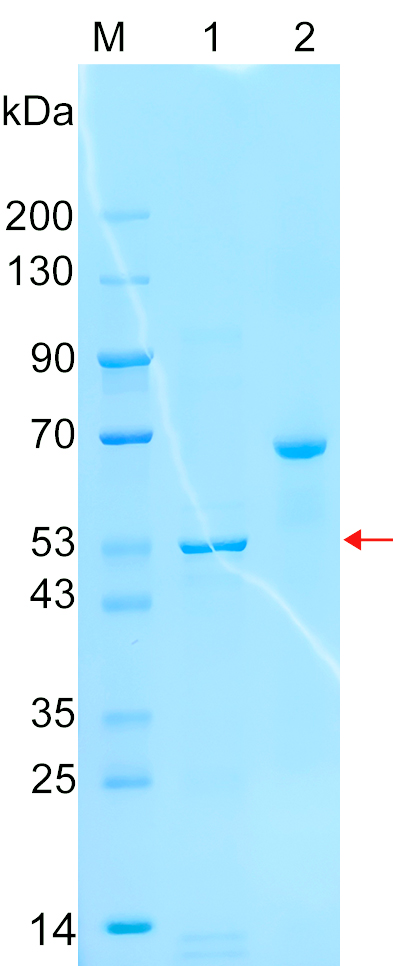
>85%, by SDS-PAGE with Coomassie Brilliant Blue staining.
-
蛋白活性
Not tested.
-
分子量
Predictes a molecular mass of 50.12 kDa. In SDS-PAGE under reducing conditions, it migrates as an approximately 52 kDa band.
-
蛋白全名
AP-1 complex subunit mu-1
-
蛋白描述
Recombinant AP-1 complex subunit mu-1 (AP1M1) fragment (residues 2-423) from Homo sapiens, encompassing the complete MHD functional domain. This high-purity protein is an essential tool for investigating clathrin-mediated vesicle trafficking, protein sorting mechanisms, and adaptor complex functions in cellular transport pathways.
The AP-1 complex subunit mu-1 is a crucial component of the clathrin-associated adaptor protein complex 1, which plays a fundamental role in protein sorting within the trans-Golgi network (TGN) and endosomes. AP complexes facilitate clathrin recruitment to membranes and recognize sorting signals in the cytosolic tails of transmembrane cargo molecules. This protein localizes to the Golgi apparatus and clathrin-coated vesicle membranes, where it functions as a peripheral membrane protein on the cytoplasmic side, forming part of the coat structure that surrounds coated vesicles at the Golgi complex. The mu-1 subunit specifically contributes to cargo recognition and sorting spe
-
检测结果
Recombinant AP1M1 protein (His tag) SDS-PAGE
M: Marker; Lane 1: AP1M1; Lane 2: BSA
-
发货形式
Lyophilized from sterile PBS, pH 7.4
-
内毒素
Please contact the lab for more information.
-
保存条件
Store it under sterile conditions at -20℃ to -80℃. It is recommended that the protein be aliquoted for optimal storage. Avoid repeated freeze-thaw cycles.